











Today, many companies already have chatbots.
They serve customers, quote, answer questions, even sell.
But there is one uncomfortable question that is rarely asked:
how do you know that your chatbot is really working well all the time?
Because in theory everything works.
But in practice…
What really happens
A customer enters your chatbot.
Ask for a product.
Try to get a quote.
Wait for a clear answer.
But:
- the bot responds somewhat incoherently
- does not understand the context
- does not follow the expected flow
- does not deliver what it should
- or simply “lost” in the conversation
And the worst:
👉 no one finds out.
No alert.
No warning.
No visibility.
Just a bad experience… that already happened.
The problem of monitoring AI with traditional logic
Most monitoring systems work like this:
- ask fixed questions
- expect specific answers
- validate whether or not it matches
But modern chatbots (AI) don’t work like that.
👉 do not always respond in the same way
👉 do not follow rigid scripts
👉 may vary language, tone, structure
Then…
traditional monitoring falls short.
A different approach: conversational monitoring
This is where dVirtualUser, a dParadig software, comes in.
Instead of validating exact answers…
👉 the entire experience is validated.
With dVirtualUser:
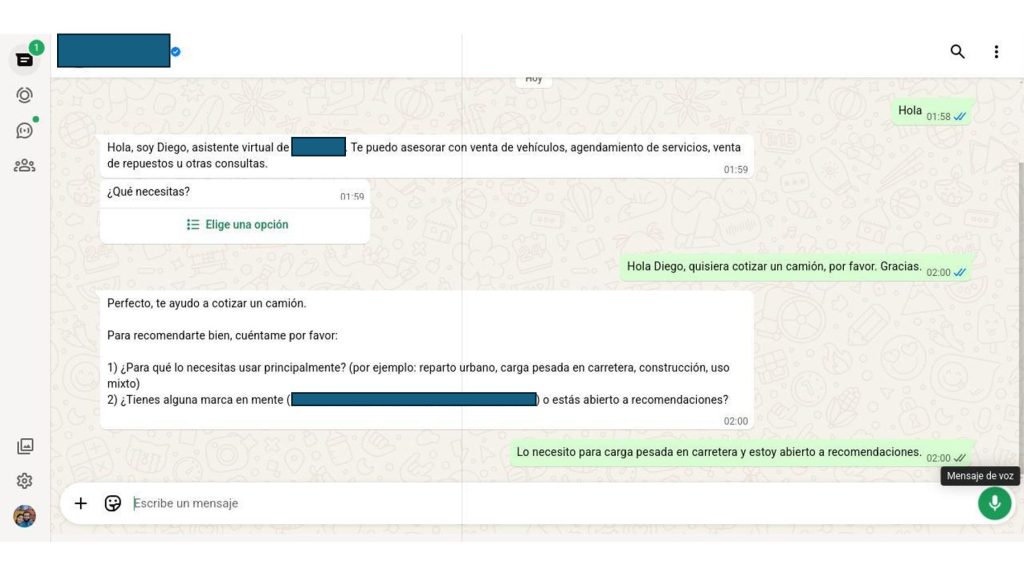
- define a natural language target
“I want to quote a truck”. - the robot initiates a real conversation
- asks questions
- interprets answers
- tries to move forward as a customer would
And most importantly:
👉 evaluates whether or not the objective is achieved.
It doesn’t matter if the chatbot responds differently each time.
The important thing is:
- did you offer the product?
- did you allow to quote?
- Did it derive correctly?
The problem is not just detecting… it’s reacting…
So far, so good.
But now comes the critical part.
Suppose something goes wrong:
- the bot does not offer the product
- does not respond correctly
- cuts off the flow
- provides incorrect information
dVirtualUser detects it.
But now the key question is:
what happens next?
If it only remains in a dashboard…
or in a report…
it’s too late.
This is where 24Cevent comes in
This is where 24Cevent takes a key role.
Because detecting a problem is of little use if no one acts in time.
When dVirtualUser identifies that something is not working as it should:
- an automatic alert is generated
- the full context is included
- evidence is attached (such as conversation or even video)
And that’s where 24Cevent comes into action:
- immediately notifies the correct team
- use effective channels (not just emails that get lost)
- ensures that someone takes charge
- scales automatically if there is no response
👉 you go from “something went wrong”
👉 to “someone is already seeing it.”
Actual example
Imagine this:
A user tries to quote a truck through your chatbot.
The chatbot:
- responds out of context
- does not follow the expected flow
- does not provide a clear choice
With traditional monitoring:
👉 probably nothing happens
With dVirtualUser ( dParadig software) + 24Cevent:
- the robot detects that the flow failed
- the entire conversation is recorded
- visual evidence is generated
- 24Cevent sends an immediate alert
- the team is notified
- someone takes the case
👉 problem is no longer invisible
The important (and not very obvious)
Today, many companies already have:
- chatbots
- IA
- automation
But few have:
actual visibility of whether it is working well
And even less:
👉 Ability to react in time when something goes wrong.
So what changes with this approach?
Raisins from:
“we have chatbot”
a:
👉 “we know if it’s working and we react when it’s not.”
And that, in automated service channels, is the difference between scaling or losing customers.
AI is transforming the way businesses serve.
But it also introduces a new challenge:
👉 monitor dynamic experiences, not fixed responses.
And in that scenario:
- dVirtualUser, dParadig‘s software, validates that the experience works
- 24Cevent ensures that someone acts when they do not
Because in the end, it is not enough to detect that something went wrong.
👉 the important thing is that someone solves it in time.
If you are already using chatbots as a support channel, this type of monitoring is no longer optional.
dVirtualUser, a software from dParadig, together with 24Cevent, allows not only to detect faults in real conversations, but also to trigger an immediate response with full context, ensuring that no problem goes unnoticed.